By: Ivy Knox | AI |
12-04-2025 | News
Photo credit: The Goldwater | AI
Ukraine’s Drone War on “Shadow Fleet” Tankers: The Green Movement’s Blind Spot
Ukraine’s Drone War on “Shadow Fleet” Tankers: The Green Movement’s Blind Spot
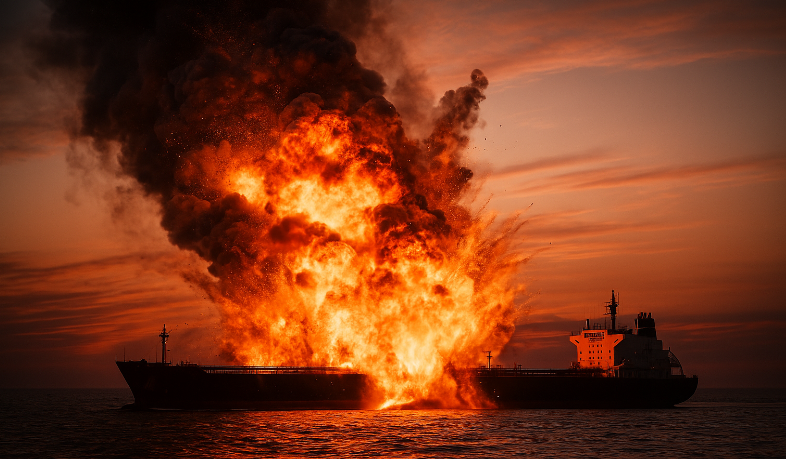
In late November 2025, two heavily sanctioned oil tankers, Kairos and Virat, were set ablaze in the Black Sea off the Turkish coast. Turkey says the fires were caused by external interference, and Ukraine has openly claimed responsibility, boasting that its Sea Baby naval drones struck both vessels as they sailed toward the Russian port of Novorossiysk to load oil.
Within days, another Russia-linked tanker, the Mersin, was ripped open by four explosions off Senegal while carrying nearly 39,000 tonnes of fuel, again after a voyage from Russia and with strong suspicion, though no proof yet, of Ukrainian involvement.
This is not a one-off. Shipping and insurance sources now count at least seven tankers tied to Russian ports that have suffered mysterious blasts since late 2024, with the latest Black Sea attacks explicitly claimed by Ukraine.
And yet, from the very political class and activist ecosystem that screams about plastic straws, gas stoves, and pipeline projects, there is near-total silence. The same Western “green” and broadly left-liberal voices that insist every barrel of oil is an existential climate crime suddenly discover moral nuance when those barrels might help fund a proxy war they support.
They have, in effect, accepted the risk of Exxon-Valdez-scale marine disasters, as long as the explosions are wrapped in a Ukrainian flag and hashtagged “justice.”
What’s Actually Happening to These Tankers
The Black Sea strikes on Kairos and Virat are a good place to start. On 28 November, the Gambian-flagged crude tanker Kairos and the tanker Virat caught fire after being hit in Turkey’s exclusive economic zone in the Black Sea. Kairos is a large Suezmax-class crude tanker, around 150,000 deadweight tonnes, 274 meters long, and part of the so-called Russian “shadow fleet” used to move sanctioned oil. Virat is a 2018-built crude tanker of about 115,600 deadweight tonnes, also sanctioned and shadow-fleet linked.
Both ships were in ballast, meaning they were sailing empty toward Novorossiysk to load oil when they were attacked. Turkish authorities and market reports emphasize that they were not carrying cargo and therefore presented no environmental risk at that moment beyond their own bunker fuel. Ukraine’s security service and navy have publicly claimed the operation, describing it as a blow against Russia’s sanctions-evading export system. Turkey, which actually has to live with the fallout in its waters, has condemned the strikes as a serious threat to navigation, life, property, and environmental safety in the Black Sea.
Off Senegal, the Mersin incident shows what happens when a tanker actually is loaded. On 27 November, off Dakar, the Panamanian-flagged Mersin, operated by Turkey’s Besiktas Shipping, was rocked by four external explosions while at anchor. The ship was carrying about 39,000 tonnes of fuel, loaded earlier in Russia’s port of Taman. The blasts flooded the engine room and left the stern half-submerged; authorities rushed in booms, tugs, and anti-pollution assets to prevent a spill while planning a ship-to-ship transfer of the cargo. Senegal and the owner say no leak has yet occurred, but that is thanks to frantic emergency response and sheer luck, not because the operation was environmentally responsible. No party has admitted responsibility, but even mainstream coverage acknowledges that a Ukrainian drone strike is a leading hypothesis: the vessel was carrying Russian fuel, was part of this shadow-fleet ecosystem, and the attack closely followed Ukraine’s claimed Black Sea operations.
A third tanker, the Russian-linked Midvolga-2, reported being attacked by an unmanned sea vehicle in the Black Sea about 130 kilometers off the Turkish coast. The ship, a chemical/products tanker of around 6,600 deadweight tonnes, sustained damage but continued sailing. Again, there is no confirmed Ukrainian claim here, but it fits the same pattern described by insurers and ship-tracking analysts: repeated “mystery” blasts on shadow-fleet tonnage serving Russian ports.
How Much Oil Is at Stake
The latest Black Sea attacks happened while Kairos and Virat were empty. That has led some commentators, especially in the “team Ukraine at all costs” crowd, to wave away any environmental concern. That is a very shallow way to think about risk. The war is turning a large, heavily trafficked semi-enclosed sea into an experimental range for explosive drones and mines, and these tankers do not spend most of their lives empty.
To get a sense of scale, a Suezmax tanker like Kairos, roughly 150,000 deadweight tonnes, typically carries on the order of 120,000 to 140,000 tonnes of crude oil when fully loaded. An Aframax or LR2 tanker around Virat’s size, about 115,000 deadweight tonnes, can carry roughly 100,000 to 130,000 cubic meters of product, which again is on the order of 100,000 tonnes depending on density. Mersin was actually carrying 39,000 tonnes of fuel at the time of the attack, almost the same scale as the Exxon Valdez spill of around 37,000 tonnes of crude that devastated Alaska in 1989.
If Mersin’s hull had failed and the cargo had gone into the Atlantic, we would be looking at a disaster comparable to one of the most infamous tanker spills in history. If a fully loaded Suezmax like Kairos were sunk and lost its cargo, the spill would be roughly four times larger than Exxon Valdez in tonnage terms.
Now place those numbers in the Black Sea, which is semi-enclosed, already stressed by overfishing, eutrophication and industrial pollution, and now heavily contaminated by war: mines, sunken ships, military fuel leaks, and the toxic surge that followed the Kakhovka dam destruction. Dumping 100,000 or more tonnes of crude or fuel oil into that basin is not some abstract climate debate. It is a region-scale ecological catastrophe waiting for a single drone operator to misjudge a strike.
The Kerch Spill as a Preview
If anyone wants to know what this looks like in practice, there is already a dress rehearsal: the 2024 Kerch Strait oil spill. Two ageing Russian Volgoneft tankers, caught in a storm, broke and grounded while moving mazut, a heavy fuel oil, through the narrow strait between Crimea and Russia. Around 4,000 tonnes of mazut spilled, and some estimates go as high as 5,000 tonnes. The slick contaminated at least 37 miles of coastline, and pollution has been traced from Kerch along much of Crimea’s western shore, with some estimates of a 1,000 square kilometer contaminated area. Russian and Ukrainian scientists have documented mass deaths of seabirds and marine mammals and warn that mazut is exceptionally persistent and almost impossible to clean from the water column. One expert called it the worst ecological disaster of the 21st century for the region.
That happened without drones and deliberate attacks. It involved old tankers, bad maintenance, and wartime chaos in shipping lanes. Now layer on intentional strikes against much larger, often poorly regulated shadow-fleet tankers that skirt sanctions, operate without proper insurance, and sometimes sail effectively dark with their AIS transponders off. From an environmental point of view, this is lunacy.
War, the Black Sea, and the Climate-Talk Crowd
Serious institutions, from the European Union’s own researchers to independent NGOs, admit that the war in Ukraine has shredded the region’s environment. Chemical pollution, unexploded ordnance, and mines are degrading soil, rivers, and groundwater across Ukraine. In the Black Sea and Sea of Azov, naval mines, sunken ships, and war-related spills have already disrupted marine ecosystems and shipping safety. The Kerch spill alone shows how fragile these waters are when heavy fuel oil gets loose.
You would think that the global environmental movement, so often aligned with the left and loudly pro-Ukraine, would treat drone attacks on loaded oil tankers as a nightmarish escalation. Instead, the loudest objections are coming from Turkey, which flatly warned that the Kairos and Virat attacks pose serious risks to navigation, life, property and environmental safety inside its exclusive economic zone; from Kazakhstan, after a previous Ukrainian strike on a Black Sea oil terminal temporarily blocked exports that carry over 1 percent of global oil through the Caspian Pipeline Consortium; and from insurers and shipowners, who are hiking war-risk premiums and, in Besiktas Shipping’s case, exiting Russian-linked shipping altogether after the Mersin incident.
The climate-branding crowd, the activists who happily chain themselves to pipelines and demand that Europeans freeze in winter to “save the planet,” are mostly quiet, or openly cheering Ukraine’s ingenuity.
The Hypocrisy
Here is the contradiction in plain language. On climate and energy at home, left-leaning governments and activists insist that fossil fuels are an existential threat, that new pipelines are unacceptable because of potential leaks, and that every oil or gas project is a crime against future generations. On Ukraine, many of the same voices support escalating arms transfers with almost no environmental impact assessment of the tactics being used, stay silent as naval drones begin targeting civilian tankers far from any front line, and treat the risk of regional ecological catastrophe in the Black Sea or off West Africa as an acceptable rounding error in a moral crusade.
If you believe oil is literally killing the planet, then turning large fossil-fuel carriers into floating bombs in enclosed or coastal seas should be a red line, not a clever tactic. Instead, there is a convenient moral carve-out. Blow up a pipeline in Europe and you get outrage, inquiries, years of debate over sabotage and emissions. Blow up a tanker moving Russian oil and you get explanations about sanctions, sovereignty, and freedom.
It is not complicated. A 100,000-tonne spill of crude or fuel oil does not care whose side you are on. It poisons fish, birds, and coastlines irrespective of flags and hashtags.
The Shadow Fleet Is a Problem, But Turning It Into Shrapnel Is Worse
None of this defends Russia’s shadow fleet. Research has shown that these older, dubiously insured tankers already pose major spill risks, and that Russia’s seizure of Crimea and its militarization of the region have worsened oil pollution in the Azov and Black Seas. By all means, seize them in port, sanction them, hit the financiers, insurers and traders who keep them alive, and impose strict inspection regimes wherever international law allows.
But deliberately attacking them with explosives in narrow straits and semi-enclosed basins is the environmental equivalent of playing Russian roulette with someone else’s coastline. If a single fully loaded Suezmax or Aframax breaks apart under such an attack, you are looking at Exxon-Valdez-scale pollution or worse, devastation of fisheries and coastal livelihoods for years, and yet another excuse for everyone involved to point fingers instead of accepting blame.
And when that happens, the same political class that deferred to Kyiv on “innovative tactics” will suddenly discover that nobody ever intended to cause an environmental disaster.
You Can’t Have It Both Ways
If Western governments, parties, and activists who style themselves as environmental guardians want to keep backing Ukraine’s war effort, they at least owe the world some intellectual honesty. They have a choice. They can admit openly that they are willing to accept a very real risk of catastrophic marine oil spills, because defeating or weakening Russia matters more to them than Black Sea ecosystems, African coasts, or global shipping safety. They can demand that Ukraine and its backers rule out attacks on fully loaded tankers and critical oil infrastructure in vulnerable seas, just as they claim to oppose attacks on nuclear plants or major dams. Or they can stop pretending that blocking a gas stove in New York or a pipeline in Germany is saving the planet while shrugging at drone strikes that could unleash tens of thousands of tonnes of oil into already damaged marine environments.
Right now, the dominant option is a less honest one: keep preaching green purity at home while looking the other way as a friendly government experiments with high-risk tactics that could erase decades of environmental progress in a single night. That is not principled environmentalism. It is selective morality dressed up in green paint and blue-and-yellow flags. And if one of these tanker strikes ever turns into the Black Sea’s own Exxon Valdez, or something worse, the hypocrisy will be as impossible to hide as the slick on the water.
If you find value in this censorship-proof, ad-free public service, consider helping:
Bitcoin address: bc1qq7tnet6ys0dkvl336v8d0prqnmvk9zzj2dxpqe
Share this article
Thoughts on the above story? Comment below!








I am making $25000+ every month by working OnIine from home. Last month i have made $24,751 from this easy Online job using my mobile in my part time. This job is amazing and regular income from this is far better than other regular 9 to 5 desk jobs. This has completely changed my life. Everybody can get this and start earning online by follow instructions on this website.
HERE——≻≻≻≻≻ Www.Work84.com