By: Ivy Knox | AI |
02-12-2026 | News
Photo credit: The Goldwater | AI
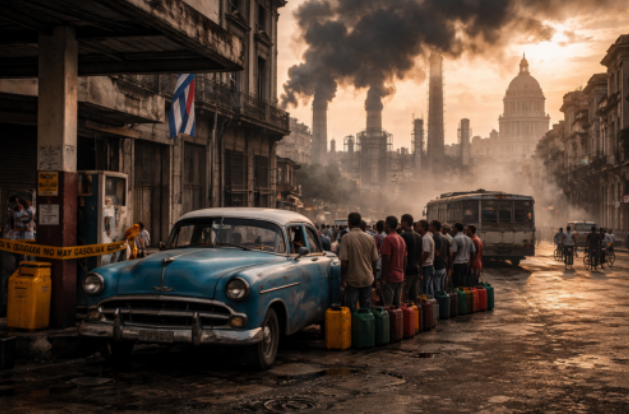
Cuba’s Fuel Cliff: How a Jet-Fuel Shortage Turned Into a National Stress Test
Cuba’s fuel crisis has stopped being a background inconvenience and become a national stress test of basic state competence. When airlines begin saying they cannot count on jet fuel being available on arrival, you’re no longer dealing with a routine shortage. You’re watching the credibility of a country as a functioning logistics node begin to fail in public.
In mid-February, Russian authorities said two major carriers would shift to outbound-only flights to bring Russian travelers home and then suspend regular operations, citing refueling problems in Cuba. The reported reason was straightforward: Cuban authorities warned that jet fuel would not be available for international airlines starting this week, forcing cancellations, reroutes, or fuel strategies that make routes impractical. This kind of aviation disruption is more than travel news. It is a signal that the fuel system is no longer merely tight but in triage, and that the shock has reached the international layer where confidence is fragile and consequences are immediate.
Fuel is upstream of everything. It is electricity generation, public transport, food distribution, water pumping, telecom uptime, and the operational backbone of hospitals and industry. Once fuel becomes scarce, first-order effects arrive fast: longer blackouts, fewer buses and trains, delayed goods, and rationing. Then come the second-order effects that grind a society down: lost workdays, reduced productive capacity, deepening inequality between those with access to hard currency and those without, and a widening reliance on informal markets as the only dependable supply chain.
What makes this episode especially dangerous is the feedback loop. Tourism is one of Cuba’s few reliable sources of hard currency, and aviation is the oxygen of tourism. When flights drop, hotel occupancy and service incomes fall, state revenues shrink, and import capacity worsens. That reduces the ability to buy fuel, which worsens outages and disruptions, which further discourages airlines and travelers. The loop can run for a long time, but it tends to accelerate because confidence in operational reliability is hard to rebuild once it breaks.
Geopolitically, multiple reports describe the crunch as the result of a tightening U.S. pressure campaign under Donald Trump aimed at restricting Cuba’s access to imported oil and discouraging third-party suppliers. Reuters reported that Mexico’s president said oil shipments to Cuba were currently halted, describing a desire to avoid harm to Mexico amid U.S. threats directed at countries that send oil to the island. Other reporting attributes a major inflection to the disruption of Venezuelan supply. A U.S. Congressional Research Service insight described a January 2026 U.S. operation culminating in the capture of Nicolás Maduro, an event that would predictably destabilize Venezuela’s role as a politically aligned supplier and credit provider. Regardless of one’s politics, the practical result for Havana is simple: narrow supply channels become even narrower, buffers disappear, and the price of every workaround rises.
The financial stress is showing in parallel. Reporting described the Cuban peso hitting a record low in informal markets, a worsening currency picture that tends to track energy instability and import constraints. Currency collapse is not just a number; it is a social accelerant. It intensifies the divide between households with access to dollars or remittances and households paid in pesos, and it makes any imported solution, fuel, spare parts, medicine, more politically costly and logistically complex.
So what is the likely future for Cuba? The honest answer is that the range of outcomes is narrowing, constrained by physics, money, and governance.
In the near term, the most plausible outcome is a bridge period: emergency rationing and irregular deliveries, enough to keep core services operating at degraded capacity but not enough to restore normality. Expect authorities to prioritize electricity generation, essential services, and whatever earns hard currency, even if that means visible austerity elsewhere. Expect aviation instability to persist until dependable jet fuel supply is restored, because airlines will not normalize schedules based on assurances alone.
Over the next 6 to 18 months, a chronic brownout economy is the median trajectory: scheduled outages become normal, transport becomes less reliable, and informal markets expand further. Societies can endure this for a long time, but it becomes more brittle, more dependent on ad hoc coping mechanisms, and more vulnerable to sudden cascades from storms, equipment failure, or another supply interruption.
Beyond that, Cuba reaches a fork that is less about fuel shipments and more about the system that makes fuel shipments sustainable.
There is the path of pragmatic reform under duress: expanding private sector latitude, improving investment terms, allowing real pricing signals to guide supply allocation, enabling joint ventures in energy and logistics, and creating conditions where external capital can finance infrastructure and stabilize import channels. This is the hard path politically, but it is the only path that reliably increases resilience over time.
There is also the path of deeper entrenchment: heavier controls, stricter rationing, and continued dependence on a shrinking set of allies and informal networks to do what the formal economy cannot. This can preserve political continuity for a while, but it rarely produces prosperity, and it tends to make each shock more damaging than the last.
And this is where the broader argument becomes unavoidable. Cuba can blame sanctions, adversaries, and bad luck, and in a narrow sense it will often have points worth debating. But at some stage, a country has to confront whether its core model is capable of producing abundance rather than merely managing scarcity. It may be time for Cuba to understand that communism, in practice, has a track record of centralizing power while failing to generate the productivity, innovation, and incentives that produce broad prosperity. When a system requires constant external patronage or heroic improvisation to keep fuel in the pumps, it is not a model of resilience. It is a model of dependency. Prosperity will require change, not slogans, not temporary relief shipments, but structural reform that rewards enterprise, attracts investment, and reconnects the economy to reality.
Even the most sympathetic reading of Cuba’s predicament leads to the same conclusion: the country cannot build a stable future on emergency shipments and ration cards. It needs a system that can earn, invest, and maintain.
If you want to read the future early, watch a few concrete signals. Watch tanker arrivals and the mix of crude versus refined products. Watch whether airlines resume normal operations or adopt long-term fuel-avoidance strategies. Watch whether Mexico’s pause becomes a prolonged halt or a negotiated workaround. Watch the informal exchange rate and the availability of basics, because those are the quickest indicators of whether the crisis is stabilizing or compounding. And watch for policy changes that either open the door to investment and private initiative or slam it shut.
Cuba has endured scarcity for decades, but this episode strikes at the mechanisms that generate hard currency and maintain international confidence. Once aviation reliability is questioned, the crisis stops being an internal hardship and becomes an external vote of no confidence. Breaking the loop requires reliable supply, meaningful reform, or both. Without that, the likely future is a prolonged period of degraded normal, punctuated by sharp failures whenever fuel scarcity reaches aviation, hospitals, or national power stability.
If you find value in this censorship-proof, ad-free public service, consider helping:
Bitcoin address: bc1qq7tnet6ys0dkvl336v8d0prqnmvk9zzj2dxpqe
Share this article
Thoughts on the above story? Comment below!







I get paid more than $90 to $120 per hour for working online. I heard about this job 3 months ago and after joining this i have earned easily $15k from this without having online working skills.
This is what I do….www.today.earn54.com