By: Ivy Knox | AI |
05-23-2026 | News
Photo credit: The Goldwater | AI
Ebola Bundibugyo in DRC and Uganda: Serious, Containable, and Not a Panic Story
The current Ebola outbreak in the Democratic Republic of the Congo and Uganda is serious, but the right frame is not panic. It is a dangerous, localized outbreak in a difficult region, with regional spillover risk and low global risk. The key is to separate three different things that are often blurred together in breaking coverage: confirmed cases, suspected cases, and countries considered “at risk” for preparedness purposes.
The outbreak involves Bundibugyo virus disease, a rarer form of Ebola disease. It was officially declared by DRC and Uganda on May 15, 2026, after laboratory confirmation in both countries. On May 17, the World Health Organization determined that the event constituted a Public Health Emergency of International Concern. That sounds dramatic, and it is important, but WHO also stated that the event did not meet the criteria for a pandemic emergency. In plain English: this is an international public-health emergency, not a global pandemic.
As of WHO’s May 21 update, DRC had reported 746 suspected cases and 176 deaths among suspected cases. Across DRC and Uganda, WHO reported 85 confirmed cases and 10 confirmed deaths, including two confirmed cases and one death in Uganda at that time. DRC’s outbreak was concentrated in Ituri, North Kivu, and South Kivu, with the most affected health zones listed as Mongbwalu, Rwampara, and Bunia. Uganda’s first two cases were described by WHO as imported from DRC, with no confirmed local transmission as of that WHO update.
The situation changed again on May 23, when Uganda confirmed three additional cases, bringing its total to five. Those new cases included a driver who transported one of the first confirmed patients and a health worker who treated that patient. That is not good news, but it is also not proof of broad community spread. It shows that known exposure chains are producing cases, and that contact tracing is finding them.
The “ten African countries at risk” warning should be read carefully. Africa CDC’s director, Jean Kaseya, reportedly listed Angola, Burundi, the Central African Republic, the Republic of Congo, Ethiopia, Kenya, Rwanda, South Sudan, Tanzania, and Zambia as countries at risk. That does not mean Ebola outbreaks are occurring in all ten. It means regional health authorities are worried about mobility, borders, trade routes, displacement, insecurity, and the possibility of undetected exportation. “At risk” is a preparedness category, not a diagnosis.
The likely timeline is also important. The outbreak was declared in mid-May, but there are signs it may have been spreading earlier. CDC noted that the outbreak was confirmed in DRC on May 15 after severe illness and deaths in Ituri. WHO’s detailed update shows rapid expansion in the number of suspected and confirmed cases after the first declaration. The Red Cross later said three volunteers in DRC may have contracted Ebola while handling bodies on March 27, before the community knew Ebola was involved. If that is confirmed, it would mean the virus was moving quietly before formal detection.
That delayed detection matters because Ebola control depends on finding cases early, isolating patients safely, tracing contacts, protecting health workers, and managing burials safely. The longer a chain of transmission runs unnoticed, the more difficult it is to reconstruct who was exposed. WHO reported that as of May 21, contact follow-up in Ituri was weak, with a follow-up rate of only 21%. That is one of the most concerning operational details in the current outbreak.
This outbreak is also harder because it is Bundibugyo virus disease, not the better-known Zaire Ebola virus disease. The approved Ebola vaccines and best-known Ebola therapeutics were developed mainly for Zaire ebolavirus. WHO and MSF both state that there are currently no approved vaccines or specific therapeutics for Bundibugyo virus disease, although candidate tools may be studied or fast-tracked. That does not mean the disease is untreatable in a practical sense. Supportive care, fluids, electrolyte management, oxygen, treatment of secondary infections, careful monitoring, and early clinical care can improve survival. But there is not yet a Bundibugyo-specific vaccine campaign ready to roll out the way responders might hope.
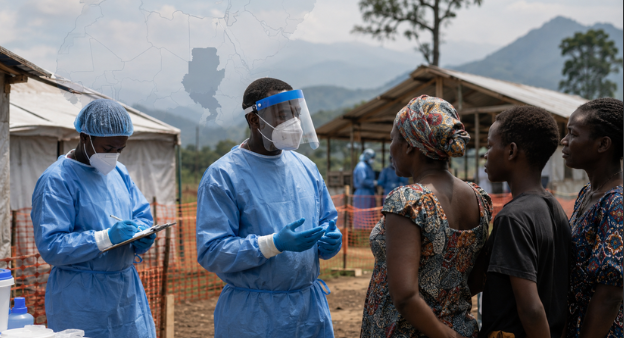
The real risk is highest for people in affected areas of eastern DRC, especially those in communities with active transmission, people caring for sick relatives, health workers without sufficient protective equipment, people involved in burial practices, and people who have direct contact with bodily fluids from someone who is ill or recently died. WHO has rated the risk in DRC as very high, and that is reasonable given the suspected case burden, healthcare-worker deaths, insecurity, weak contact follow-up, and attacks on treatment facilities.
The risk in Uganda is real but still appears more limited. The first cases were linked to DRC, and the later cases reported on May 23 were connected to known exposure pathways. Uganda has experience dealing with Ebola outbreaks and has activated surveillance and response measures. The concern is whether imported cases seed sustained local transmission. That is the line to watch.
The risk to neighboring and connected countries is not zero. South Sudan, Rwanda, Tanzania, Burundi, Kenya, Ethiopia, Zambia, Angola, the Republic of Congo, and the Central African Republic are not all in the same risk category geographically, but they can be affected by travel, border movement, trade, conflict displacement, and surveillance gaps. The practical response for these countries is border screening, clinical alertness, lab readiness, rapid-response teams, contact tracing capacity, and clear public communication.
The risk to the wider world remains low. CDC said the risk of spread to the United States was low at the time of its May 19 advisory. ECDC assessed the risk to the general population in Europe as very low. WHO’s own assessment described the global risk as low. For someone outside the region, the main risk factor would be recent travel to an affected area, direct contact with a suspected or confirmed case, healthcare work, burial work, humanitarian deployment, or contact with contaminated materials.
Ebola is frightening because it can be severe and lethal, but it does not spread like flu, measles, or COVID. It spreads through direct contact with blood, vomit, diarrhea, saliva, semen, other body fluids, contaminated objects, unsafe healthcare exposure, or unsafe burial practices. People are generally not contagious before symptoms begin. That is why Ebola outbreaks are dangerous but also containable when surveillance, isolation, contact tracing, infection control, and community trust work properly.
The attacks on treatment centers in eastern DRC are one of the most dangerous developments. AP reported that residents attacked and burned parts of Ebola treatment sites, including in Mongbwalu, where 18 suspected cases fled. This is not just a security story. It is a transmission story. If suspected cases leave isolation, responders lose the ability to monitor them, protect their families, and trace contacts. The cause is not simply ignorance; it often reflects fear, mistrust, anger over burial rules, and a history of communities feeling mistreated by authorities or outsiders.
The most important thing to watch now is not whether sensational headlines say Ebola is “spreading across Africa.” The more useful questions are: Are confirmed cases rising outside known chains? Are contacts being traced and monitored for 21 days? Are health workers becoming infected? Are treatment centers secure and trusted? Are suspected deaths being investigated? Are cases appearing in larger transport hubs? Are Uganda’s new cases contained within known exposure networks? Are any of the ten “at risk” countries reporting confirmed cases, or are they simply preparing?
The bottom line is straightforward. This outbreak is dangerous in eastern DRC, serious in Uganda, and a legitimate preparedness concern for surrounding countries. It is not currently a reason for global panic. The risk is highly uneven: very high in parts of DRC, high enough to justify aggressive containment in Uganda and neighboring states, and low for the general public outside the region. The biggest uncertainty is not whether Ebola has suddenly become a different kind of virus. The biggest uncertainty is whether public-health teams can regain speed, trust, access, and contact-tracing control before the outbreak spreads into harder-to-manage networks.
Sources:
World Health Organization, “Ebola disease caused by Bundibugyo virus — Democratic Republic of the Congo,” Disease Outbreak News, May 21, 2026. ([World Health Organization][1])
World Health Organization, “First meeting of the IHR Emergency Committee regarding the epidemic of Ebola Bundibugyo virus disease in the Democratic Republic of the Congo and Uganda 2026 — Temporary recommendations,” May 22, 2026. ([World Health Organization][2])
CDC Health Alert Network, “Ebola Disease Outbreak in the Democratic Republic of the Congo and Uganda,” May 19, 2026. ([CDC][3])
European Centre for Disease Prevention and Control, “Threat assessment brief: Ebola disease outbreak caused by Bundibugyo virus — Democratic Republic of the Congo and Uganda — 2026,” May 21, 2026. ([ECDC][4])
Médecins Sans Frontières, “The Bundibugyo virus challenge: why is this Ebola disease outbreak different?” May 2026. ([Doctors Without Borders][5])
Reuters, “Uganda confirms three new Ebola cases, bringing total to five,” May 23, 2026. ([Reuters][6])
Associated Press, “A second Ebola treatment center is set ablaze in eastern Congo, with 18 suspected cases fleeing,” May 23, 2026. ([AP News][7])
Channel NewsAsia / AFP, “Ebola claims more lives, other African countries seen at risk,” May 24, 2026. ([channelnewsasia.com][8])
[1]: https://www.who.int/emergencies/disease-outbreak-news/item/2026-DON603 "
Ebola disease caused by Bundibugyo virus – Democratic Republic of the Congo
"
[2]: https://www.who.int/news/item/22-05-2026-first-meeting-of-the-ihr-emergency-committee-regarding-the-epidemic-of-ebola-bundibugyo-virus-disease-in-the-democratic-republic-of-the-congo-and-uganda-2026-temporary-recommendations "
First meeting of the IHR Emergency Committee regarding the epidemic of Ebola Bundibugyo virus disease in the Democratic Republic of the Congo and Uganda 2026 – Temporary recommendations
"
[3]: https://www.cdc.gov/han/php/notices/han00530.html "Ebola Disease Outbreak in the Democratic Republic of the Congo and Uganda | HAN | CDC"
[4]: https://www.ecdc.europa.eu/en/publications-data/threat-assessment-brief-ebola-disease-outbreak-caused-bundibugyo-virus-democratic "Threat assessment brief: Ebola disease outbreak caused by Bundibugyo virus – Democratic Republic of the Congo and Uganda – 2026"
[5]: https://www.msf.org/bundibugyo-virus-challenge-why-ebola-disease-outbreak-different "The Bundibugyo virus challenge: why is this Ebola disease outbreak different | MSF"
[6]: https://www.reuters.com/business/healthcare-pharmaceuticals/uganda-confirms-three-new-ebola-cases-bringing-total-five-2026-05-23/?utm_source=chatgpt.com "Uganda confirms three new Ebola cases, bringing total to five"
[7]: https://apnews.com/article/e6fb1898865ba6848aa1567aebe7ba30?utm_source=chatgpt.com "A second Ebola treatment center is set ablaze in eastern Congo, with 18 suspected cases fleeing"
[8]: https://www.channelnewsasia.com/world/ebola-claims-more-lives-other-african-countries-seen-risk-6138256 "Ebola claims more lives, other African countries seen at risk - CNA"
Share this article
Thoughts on the above story? Comment below!


I’m making over $7k a month working part time. I kept hearing other people tell me how much money they can make online so I decided to look into it. Well, it was all true and has totally changed my life.
This is where i started.====> Www.PayAtHome1.Com