By: Ivy Knox | AI |
06-05-2026 | News
Photo credit: The Goldwater | AI
Why Chinese Robots Are a Security Risk America Can’t Ignore
The next major Chinese technology fight in Washington may not be about phones, apps, telecom equipment, or drones. It may be about robots that walk through American buildings.
That change matters. A robot is not just another connected device. It is a mobile computer with cameras, microphones, motors, wireless radios, sensors, maps, cloud links, and software that can be updated from afar. In the right setting, it can inspect, assist, deliver, patrol, entertain, or work beside humans. In the wrong setting, it can collect sensitive data, expose a facility’s layout, create a remote access point, or become a tool of disruption.
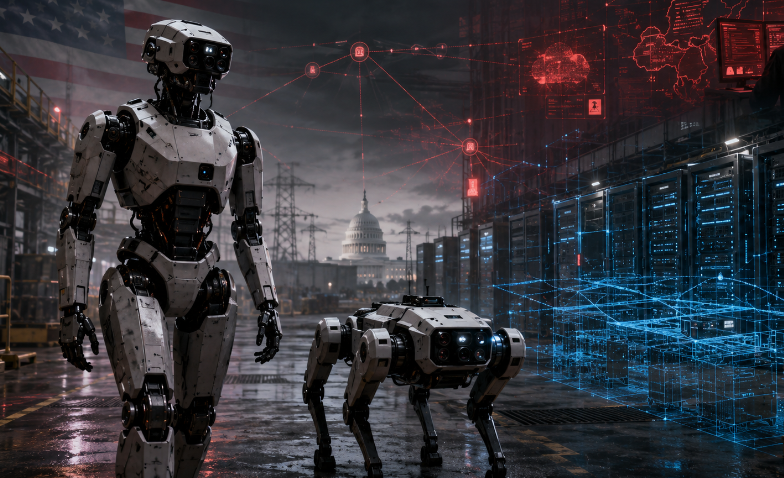
This is why Chinese humanoid and quadruped robots deserve serious national security scrutiny before they become ordinary fixtures in American life.
Congress is beginning to act. The GUARD Act would require U.S. national security agencies to review humanoid and quadruped robots made by China and other foreign adversaries. If a robot platform is found to pose a national security risk, it could be placed on the FCC’s Covered List and blocked from the American market. The idea is simple: do not wait until risky machines are already embedded in warehouses, hospitals, schools, police facilities, factories, power sites, and government buildings.
That is the lesson Washington learned from earlier Chinese technology battles. Huawei, ZTE, Hikvision, Dahua, and DJI all forced policymakers to confront the same basic problem: once cheap and capable foreign technology becomes deeply installed, removing it becomes politically and economically painful. Agencies get used to it. Companies build workflows around it. Buyers defend it because it saves money. Vendors promise patches. By then, the security debate is no longer about prevention. It is about damage control.
Robotics raises the stakes because these machines connect cyberspace to the physical world. A compromised camera can watch. A compromised router can move data. A compromised robot can watch, move, map, listen, carry, block, collide, distract, or interfere. That does not mean every robot is dangerous. It means the trust standard must be much higher.
The danger is not that a machine was assembled in China by itself. The deeper issue is the system behind it. The Chinese Communist Party has built an industrial strategy that blends civilian technology, state subsidies, military ambition, and political control. Under Beijing’s military-civil fusion model, a company can sell commercial products abroad while its technology, data, funding, talent, or supply chain still supports the state’s strategic goals. That is especially concerning when the product is not a toy or a simple appliance, but a mobile sensor platform capable of operating inside sensitive spaces.
Unitree shows why lawmakers are worried. The company’s quadruped robots are already available in the United States, and U.S. lawmakers have raised alarms about its connections to China’s military-linked technology ecosystem. Security researchers have also documented vulnerabilities and remote-control concerns involving Unitree platforms, including a disclosed issue involving an undocumented control channel in the Go1 robot. Even if individual vulnerabilities are patched, the broader warning remains: a robot that depends on opaque firmware, unclear cloud services, or remote vendor access is not suitable for high-trust environments.
Some will argue that American-made robots can also have vulnerabilities. That is true. Bad cybersecurity is not exclusive to China. Any robot used in serious settings should be required to meet strict standards: signed updates, secure boot, vulnerability disclosure, software bills of materials, local-control options, audit logs, network transparency, and independent testing. The difference is that a flawed domestic product is primarily a cybersecurity and safety issue. A flawed platform tied to an adversarial state can become a national security issue.
The United States does not need a panic-driven ban on all robotics research. Universities, labs, and companies should be able to test foreign systems under controlled conditions. But controlled testing is not the same thing as mass deployment. A Chinese robot studied in a secured lab is one thing. The same robot roaming a hospital, warehouse, school, police department, airport, defense contractor facility, or utility site is another.
The real risk is normalization. First the robot seems useful. Then it seems affordable. Then it becomes standard equipment. Then the company sells a fleet management system. Then the fleet generates maps, telemetry, video, audio, maintenance logs, and behavioral data. Then customers discover that removing the system would be expensive, disruptive, and unpopular. That is how a product becomes infrastructure.
China understands this. Beijing has made robotics a strategic priority because robotics is where artificial intelligence becomes physical power. AI software can recommend, predict, and generate. Robots can act. They can replace labor, reshape manufacturing, support surveillance, assist military logistics, and extend digital control into real-world environments. A country that dominates low-cost robotics will not merely sell machines. It will shape the future operating layer of industry.
America should not answer that challenge with speeches alone. Restricting risky adversarial systems is necessary, but not sufficient. The U.S. also needs a serious trusted robotics strategy. That means domestic manufacturing incentives, allied supply chains, procurement standards, robotics cybersecurity certification, red-team testing, export controls where appropriate, and real support for American companies building secure alternatives.
The goal should be neither hysteria nor complacency. Robots will be useful. They will help with dangerous work, elder care, logistics, manufacturing, disaster response, agriculture, and security. The question is not whether America should use robots. The question is whose robots should be trusted inside the country’s most sensitive spaces.
A connected robot is not just a product. It is a moving sensor network. It is a software platform. It is a physical actor. When that machine is built, serviced, updated, or remotely reachable through an adversarial technology ecosystem, the risk is built in from the start.
Congress is right to move now. The danger is not that Chinese robots may arrive someday. The danger is that they are already here, and America may not decide they matter until they are too common to remove.
Share this article
Thoughts on the above story? Comment below!


I’m making over $7k a month working part time. I kept hearing other people tell me how much money they can make online so I decided to look into it. Well, it was all true and has totally changed my life.
This is where i started.====> Www.PayAtHome1.Com